In our last blog, we explored capital and funding, the fuel that powers innovation and growth. This blog looks into KSF 4: Talent and Community Building.
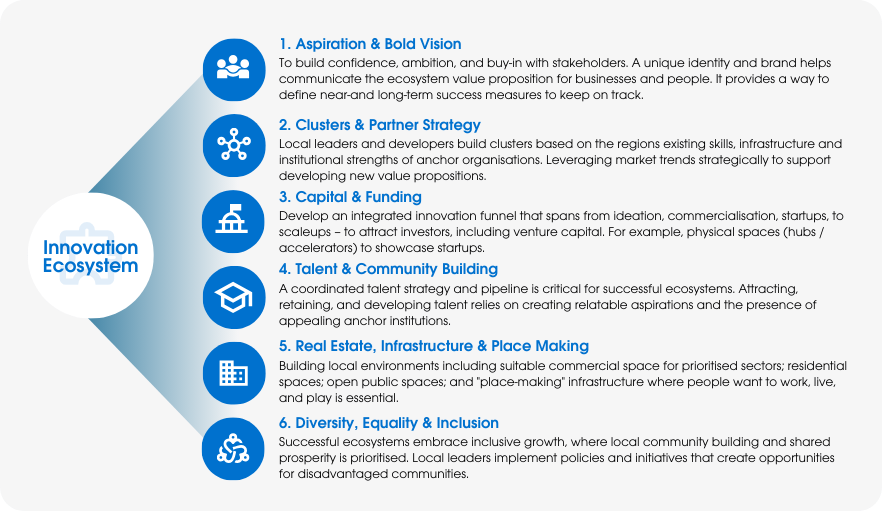
A coordinated talent pipeline is essential for thriving innovation ecosystems. Attracting, developing, and retaining talent hinges on relatable aspirations, appealing anchor institutions, and strong alignment between education and business needs.
Educational institutions must tailor their offerings to the ecosystem’s strengths, whilst also equipping talent with critical skills digital and green skills demanded in today’s evolving economy. Beyond traditional degrees, ecosystems should rethink workforce development strategies by emphasising certifications, reskilling programs, and ensuring inclusive access to education.
Ecosystems must also combat challenges like brain drain, ensuring that people want to stay and grow locally. This requires fostering an environment where individuals see long-term career and lifestyle opportunities. Initiatives such as loan forgiveness for graduates who stay in the region and expanded degree programs aligned with ecosystem goals can be pivotal for retention.
Collaboration between businesses and educational institutions is key. Employers should clearly define the skills they need, while schools and training providers offer tailored programs to meet this demand. Opportunities for students, such as internships, apprenticeships, and work experience, enable them to gain practical skills and transition seamlessly into the workforce.
Events and initiatives are vital for building community and fostering collaboration. These create opportunities for students, businesses, investors, educational institutions and public-sector players to interact, driving knowledge-sharing and cross-sector innovation. Such interactions open minds to new possibilities
Ecosystems must invest in business support for startups, scale-ups and beyond, providing resources for commercialisation, financing education, and expansion opportunities.
Together, these elements form a cohesive strategy for developing talent and sustaining a vibrant innovation community.
Case Studies
Boston-Cambridge Innovation Ecosystem: Kendall Square
The Cambridge Innovation Centre (CIC) and Venture Café, exemplify how intentionally designed spaces and programs can foster talent development and build vibrant innovation communities.
Founded in Kendall Square, CIC created a flexible, high-quality co-working environment that has hosted over 700 companies, including around 500 startups. By deliberately mixing companies across floors rather than by sector, CIC encouraged “cross-fertilisation of innovative ideas,” enabling entrepreneurs to learn from each other organically. CIC’s physical design promotes informal interactions, with common kitchens and shared spaces that encourage serendipitous encounters between innovators. This proximity has been shown to boost collaboration, as researchers at MIT found faculty were more likely to co-author papers or patents when located near one another. The CIC model demonstrates how curated environments can make talent feel connected and inspired, reducing barriers to collaboration.
Venture Café, created by the CIC team, complements this environment by hosting regular events like Thursday Gatherings. These events bring together entrepreneurs, investors, corporate leaders, students, and mentors, providing networking opportunities that help innovators gain critical insights, find partners, and secure funding. The gatherings create a rhythm of community engagement that sustains momentum in the ecosystem.
Thoughtfully designed spaces and consistent promotion of community engagement can attract, develop, and retain talent, creating a community of talented individuals – all of which are essential for curating a strong innovation ecosystem
Skills WMW: Employer Skills Report
The West Midlands and Warwickshire (WMW) region provides a strong example of how a clear strategy can effectively align employer needs with education to serve the regional economy. Whitecap Consulting was commissioned by WMW Further Education (FE) providers to build on the WMW Local Skills Improvement Plan (LSIP) to:
- Understand current and future employer skills needs
- Shape a more agile and responsive FE skills offer
- Strengthen collaboration and engagement between employers and educators
across four priority sectors including Construction, Engineering and Manufacturing, Digital and ICT, and Logistics and Distribution.
Using a combination of desk research, market analysis, and curriculum mapping, Whitecap gained detailed insights into industry trends, emerging technologies, and the current education and skills provision across the four sectors, highlighting both areas of alignment and gaps in delivery. Additionally, one-to-one, in-depth discussions with employers provided rich, nuanced insights into the challenges businesses face regarding skills shortages.
A key recommendation from the report is the concept of “co-opetition” – a strategic blend of cooperation and healthy competition among FE providers. By sharing expertise and resources on priority skills while maintaining individual strengths, FE institutions can optimise resource allocation whilst strengthening the region’s collective brand, making it more attractive to students and employers. This collaborative mindset underpins the launch of the Skills WMW brand and the creation of a new “one-stop shop” website, designed to streamline employer engagement and improve student access to opportunities.
This coordinated strategy for FE institutions are laying the foundation for a more connected and future-ready workforce. By aligning education with evolving business needs, directly involving employers in curriculum development, and proactively addressing skills shortages, WMW is setting a benchmark for how regions can build resilient, agile talent pipelines that drive economic growth and meet the demands of tomorrow’s industries.
Key Takeaways
- Talent is the foundation of innovation:Thriving innovation ecosystems rely on attracting, developing, and retaining talent. This requires a coordinated approach that aligns educational offerings with business needs, fosters collaboration between employers and schools, and creates an environment where individuals see long-term career opportunities.
- Community building is crucial for collaboration: Intentionally designed spaces and events, like those in the Boston-Cambridge ecosystem, are essential for fostering a sense of community. These environments encourage informal interactions and knowledge-sharing, which can lead to serendipitous collaborations and cross-sector innovation.
- Strategic alignment drives success:Regions can build a resilient talent pipeline by having a clear strategy. The West Midlands and Warwickshire (WMW) case study demonstrates how aligning education with evolving business needs and involving employers in curriculum development can proactively address skills shortages and drive economic growth.
Next in the Series: Real Estate, Infrastructure and Place Making
Our next blog will explore how high-quality real estate, thoughtful infrastructure, and intentional placemaking create the physical environments that enable innovation ecosystems to flourish, transforming spaces into dynamic hubs for work, living, and creativity.
- Blog 1: An Introduction to Innovation Ecosystems
- Blog 2: Aspiration and Bold Vision
- Blog 3: Clusters and Partner Strategy
- Blog 4: Capital and Funding
- Blog 5: Talent and Community Building
- Blog 6: Real Estate, Infrastructure and Place Making
- Blog 7: Diversity, Equality and Inclusion
At Whitecap, we support organisations in building and enhancing innovation ecosystems. In addition to working directly with clients, we conduct research and analysis to inform strategic decision-making and thought leadership. If you need support with a project or are looking to develop an innovation ecosystem, get in touch.