 Whitecap Consulting was in Manchester on 25th November for the second in a series of three workshops delivered in partnership with Innovate UK Business Connect, exploring practical approaches to innovation across the Professional & Financial Services sectors. Building on our earlier work on digital adoption, AI literacy and responsible innovation, this session focused on equipping organisations with the insight, confidence and practical frameworks needed to adopt AI in a safe, effective and commercially grounded way.
Setting the Scene
The day began with an introduction from Winn Faria of Innovate UK, who outlined the objectives of the programme and the broader ambitions of Innovate UK’s Next Generation Services initiative. This set the tone for a highly practical and interactive session designed to help organisations understand both the opportunities and risks associated with AI adoption.
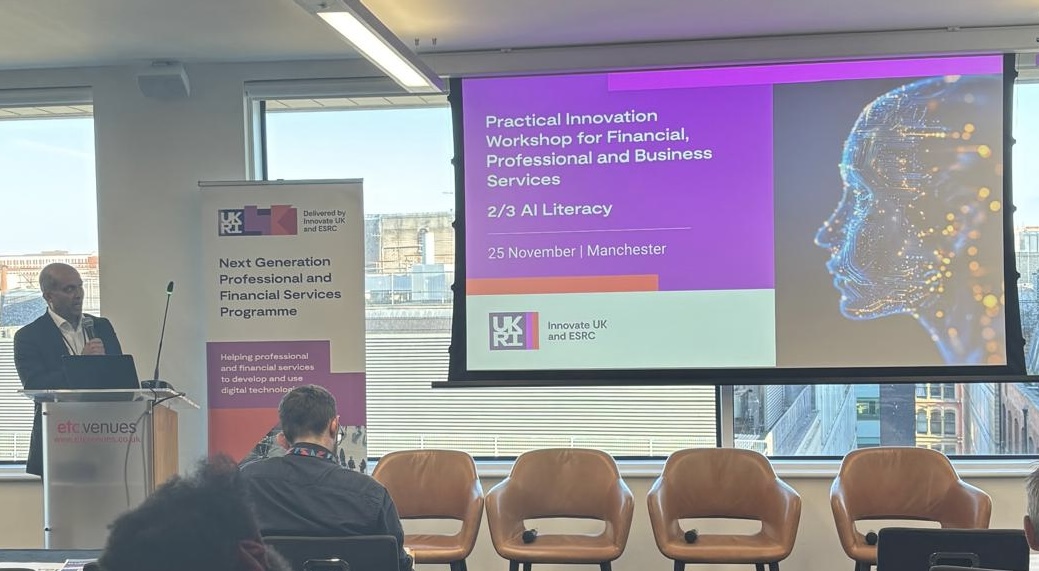
Panel Discussion: Practical Guidance for AI Adoption
The morning featured a panel discussion moderated by Dr Rob Firth, Senior Research AI Scientist at the STFC Hartree Centre, which included Ben Brownson (Group Board Director and Head of Operations, RPG) and Katy Sidebotham (Legal Technologist, Weightmans).
. Bringing together perspectives from legal services, financial services and AI research, the discussion explored the realities of implementing AI within complex professional environments.
A consistent theme was the need to start with the problem, not the tool. Several panellists stressed that organisations are often tempted to begin with a solution (particularly when vendor offerings are evolving rapidly) but the most successful AI adoption starts by understanding the root cause of a challenge. The importance of horizon scanning and networking beyond one’s immediate sector was also highlighted, with participants noting that keeping up with change is difficult but essential.
The conversation explored the value of creating an experimentation culture, supported by teams who are open, curious and willing to test new ideas. Stakeholder management was identified as critical to success, especially as levels of technical familiarity vary widely across organisations. Bringing people along on the journey – supported by training and education – can significantly improve confidence and quality during adoption.
Several contributors emphasised that AI will inevitably fail at times, often in unexpected ways. Creating safe environments where experimentation is encouraged, and where failure is anticipated and understood, is essential. Trust was noted as a key enabler of adoption: the pace at which organisations can implement AI often correlates with how quickly they can build trust in the underlying technology.
Risk management emerged as another major theme. AI introduces both operational and commercial risks, and participants noted the importance of understanding an organisation’s risk appetite early in the process. Data security remains a priority, particularly where generative AI models may expose information unless adequately protected within secure environments.
The discussion also explored the tension between automation and professional development. While AI can support efficiency, over-reliance (particularly among junior staff) may stunt the development of critical thinking and foundational skills. Training, reflective practice and intentional use of AI were therefore seen as essential in ensuring that the technology enhances rather than diminishes capability.
Change management was described as an increasingly important organisational skill. Successful AI adoption often requires direct, supportive engagement with teams, giving people time to adjust and ensuring they understand both new workflows and how their data will be used. Panellists noted that change is typically iterative: technology evolves, teams learn, and processes improve over time.
Finally, participants discussed the challenges facing organisations with legacy systems. In some cases, meaningful AI adoption may require foundational redesign of technology architecture, a strategic decision that can feel like several steps back in order to move forward. There was shared frustration around vendor-led forced upgrades, where AI features are added without solving a meaningful problem, increasing cost and risk for businesses without delivering clear benefit. Transparency, it was agreed, is fundamental to responsible adoption.
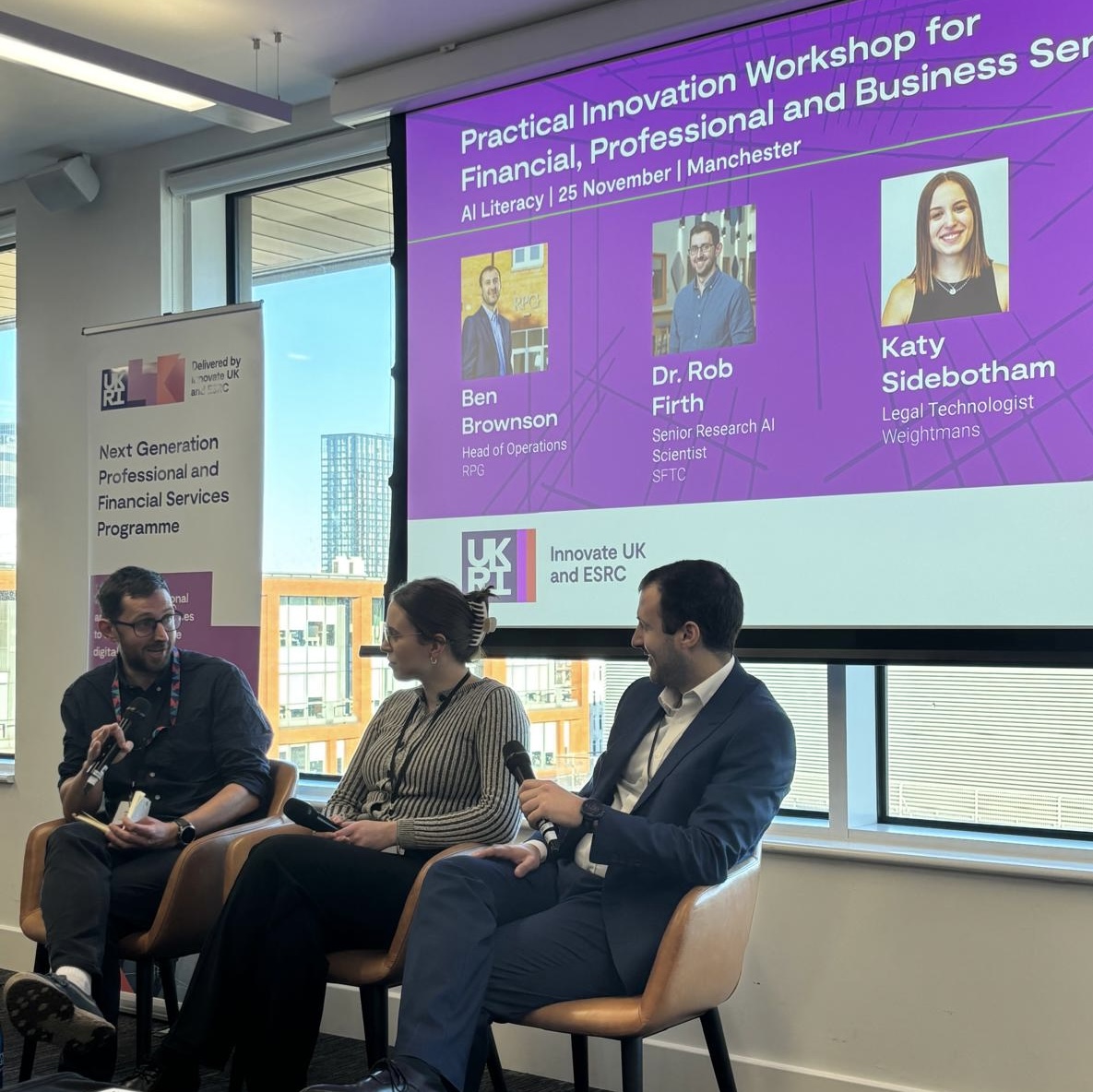 Q&A: Opportunities, Implementation and Skills
During the Q&A, attendees explored practical considerations including the use of predictive AI, prompt-writing techniques and strategies for implementation.
Predictive AI was highlighted as a major opportunity, such as analysing capacity and utilisation data to match people to the right work at the right time. When discussing implementation strategies, contributors emphasised the need to understand risk appetite, create clear reference materials, and ensure visible leadership involvement. Identifying internal champions can accelerate adoption and support cultural change.
On skills, the panel discussed the importance of reinvesting the time saved through automation into upskilling. Participants also examined approaches to prompt design, emphasising the importance of context and experimentation. As generative AI continues to evolve, historic prompts may begin to influence outputs at the individual, team or organisational level, representing a future risk that organisations should monitor.
The group also explored the potential of tools such as Microsoft Copilot, including the ability to select different large language models for specific tasks, enabling more tailored deployment of AI.
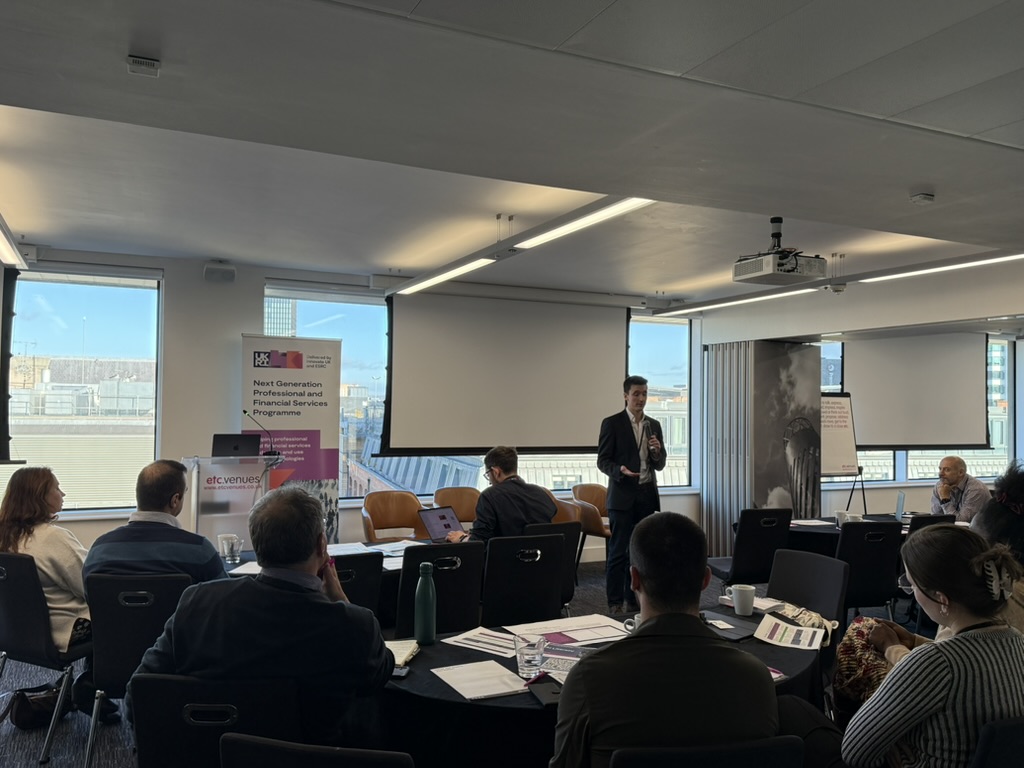
In the afternoon, the Whitecap team of Julian Wells and Michael Fletcher ran workshop for participants, which provided an interactive opportunity to engage with the frameworks from the practical Guide to AI Literacy for Professional and Financial Services Firms, which was recently published by Innovate UK.
Looking Ahead
The Manchester workshop built on the themes emerging from the first session in Edinburgh and offered highly practical guidance for organisations at different stages of AI maturity. Across both sessions, several core messages have emerged: the importance of problem-first design, the need for safe experimentation, the centrality of trust and governance, and the critical role of people (in the context of skills, culture and change) in enabling effective adoption.
Whitecap Consulting is pleased to continue supporting Innovate UK Business Connect in this programme, and to collaboratively explore how the Professional & Financial Services sectors can harness innovation to drive sustainable and responsible growth.
Further Reading
Read the write up from all the workshops in this series here:
- Responsible Innovation (Edinburgh)
- AI Literacy (Manchester)
- Digital Adoption (Birmingham)
Read the Practical Guides here:
- Guide to AI Literacy for Professional and Financial Services Firms
- Guide to Responsible Innovation for Professional and Financial Services Firms
- Guide to Digital Adoption for Professional and Financial Services Firms