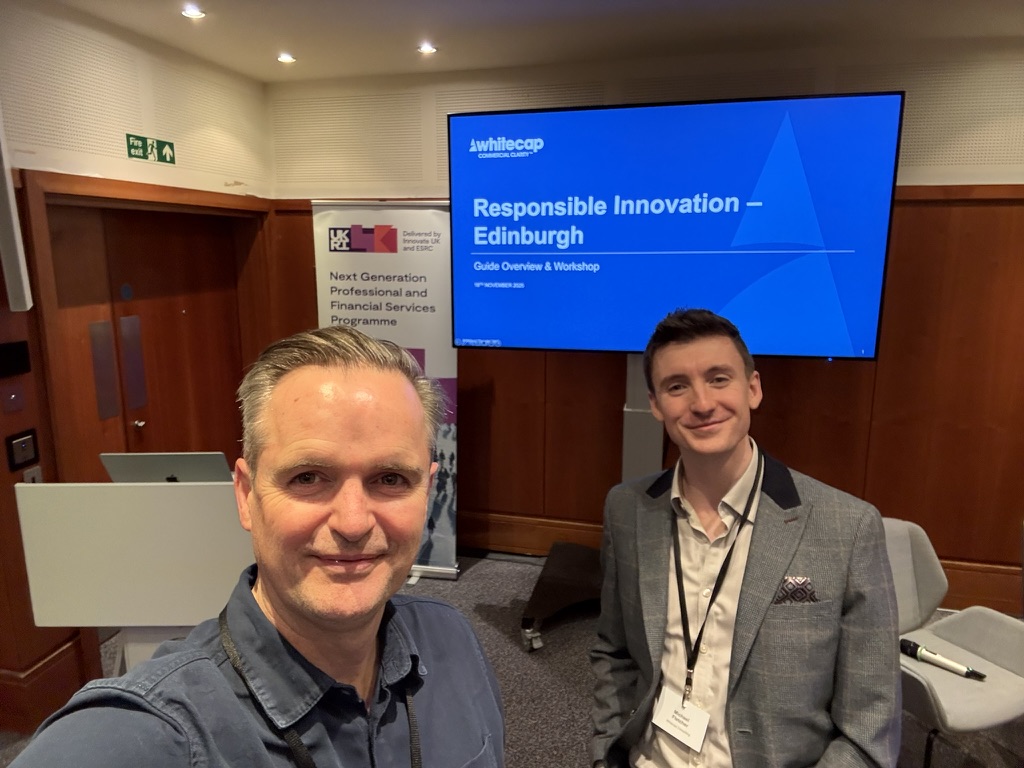
 The Whitecap team was in Edinburgh on 18th November for the first in a new series of workshops delivered in partnership with Innovate UK, exploring innovation across the Professional & Financial Services sectors. Building on our previous collaboration on digital adoption, AI literacy and responsible innovation, this programme aims to deepen understanding and stimulate practical ideas that can support the sector’s future growth.
This inaugural session focused on Responsible Innovation, a highly topical theme as organisations navigate rapid advances in AI, data, and digital technologies. The workshop brought together industry leaders, entrepreneurs, academics and innovators to consider how responsible practice can be embedded without compromising commercial ambition.
Setting the Scene
The day opened with an introduction from Martin Martinoff of Innovate UK, framing the workshop against the backdrop of the UK Industrial Strategy and signalling that £150 million will be invested into the Professional, Financial and Business Services (PFBS) sector. This provides a timely opportunity to examine how responsible innovation can shape and accelerate sustainable growth.
 Keynote: The Case for Trustworthy, Ethical and Inclusive AI
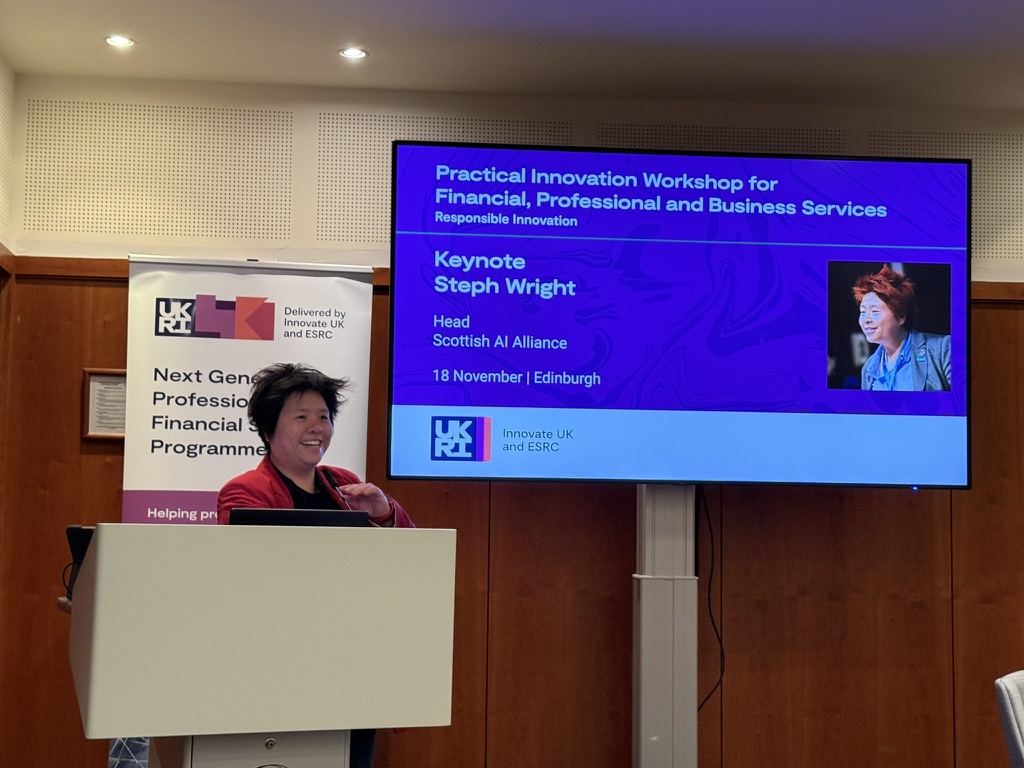
The keynote was delivered by Steph Wright from the Scottish AI Alliance, who emphasised Scotland’s ambition to become a global leader in trustworthy and inclusive AI. She encouraged participants to move beyond the question of how society should adapt to AI, and instead consider what kind of AI we want to build – and how it should adapt to us. Steph argued that responsible innovation begins not with building ethically, but with determining whether we should build something at all; not all innovation represents progress, and sometimes the most responsible choice is to hold back. She warned that responsibility without ethics risks becoming a mere compliance exercise, and emphasised the need for organisations to make conscious choices about where they draw their ethical boundaries. AI, she noted, is not an inevitable force but the result of human decisions, and its deployment must be matched with genuine understanding rather than rapid, uncritical adoption. Steph closed by highlighting practical support available to organisations, including Scotland’s free AI learning resources and the Scottish AI Playbook.
 Panel Discussion: Themes and Insights
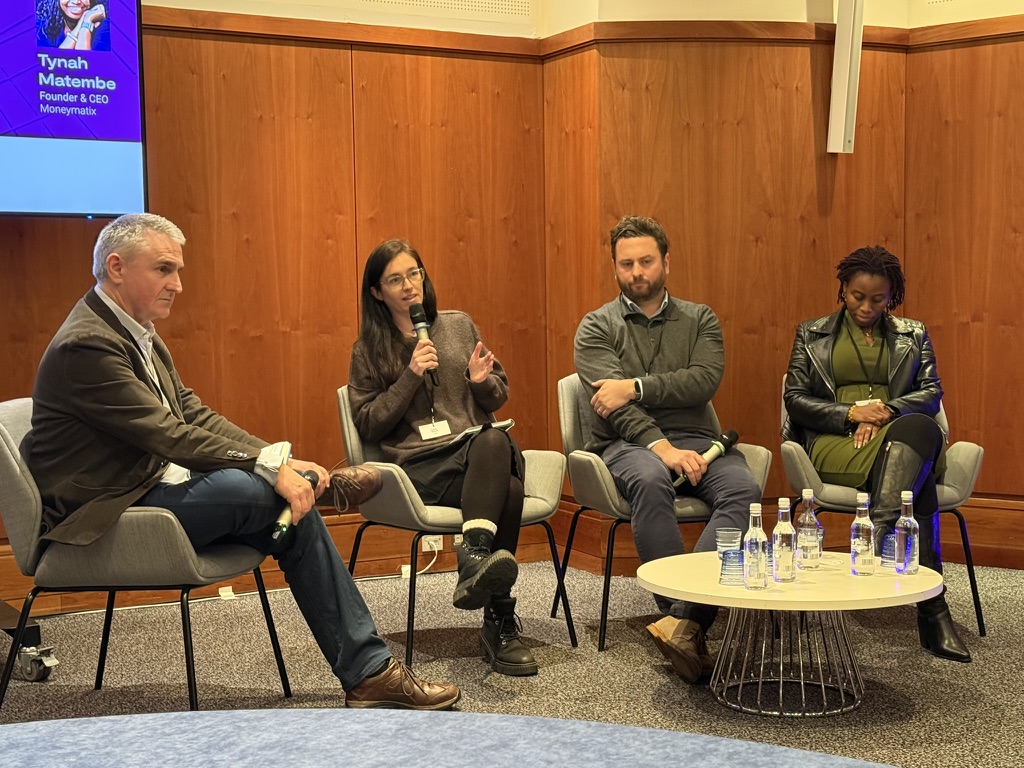
A lively panel discussion followed, offering a blend of entrepreneurial, academic and commercial perspectives. Several common themes emerged across the conversation.
One recurring insight was the challenge of balancing responsible design with commercial viability. Many organisations, particularly those addressing societal issues, begin with a strong sense of purpose but find that solving meaningful problems does not always correlate with profitability. Data-driven models were highlighted as one way to close this gap, helping businesses understand user outcomes and create value for partners.
The discussion also touched on the importance of focusing on clearly defined user groups. Rather than building for everyone at once, success often comes from narrowing the persona set and ensuring the needs of those users are deeply understood and met.
Another theme centred on the regulatory and cultural environment for innovation in the UK. While regulation can sometimes be restrictive, cultural attitudes to risk and compliance were described as an even greater barrier. Several panelists noted that organisations may default to saying no, even when no rule explicitly prohibits a new idea – a mindset that can limit experimentation.
The conversation also explored the tension between economic performance and responsible innovation. Some argued that the UK’s current economic climate demands bold action and faster commercialisation, while responsible innovation frameworks can risk slowing momentum. Others emphasised that purpose-driven innovation must still be rooted in commercial fundamentals: revenue, sustainability and viable business models remain essential.
AI’s role in transforming professional and financial services was a consistent thread. Participants agreed that AI-driven disruption is inevitable and already accelerating. At the same time, many stressed the importance of keeping humans involved in decision-making—particularly in sensitive contexts such as legal processes – while also accepting that both humans and AI systems are capable of making mistakes.
 Afternoon Workshop: Developing a Responsible Innovation Concept
In the afternoon, Julian Wells and Michael Fletcher from Whitecap Consulting led a hands-on workshop designed to translate the morning’s themes into practical application.
Participants worked collaboratively to design a concept for a new LegalTech startup supporting individuals experiencing relationship separation. The group was tasked with balancing two competing imperatives:
-
Responsible design principles – safeguarding vulnerable users, ensuring fairness, maintaining transparency, and placing human judgement at critical points.
-
Commercial viability – ensuring the concept could grow sustainably, generate revenue, and provide customers with tangible value.
The resulting concept demonstrated that responsible thinking and commercial grounding can co-exist, but achieving the right equilibrium is far from straightforward. The exercise generated discussion about topics such as user needs, business models, data usage, ethical boundaries, and opportunities for innovation across professional services.
Looking Ahead
This session marked the first of three workshops in a series. Over the upcoming sessions (Manchester 25/11 and Birmingham 26/11), we will continue to explore how the Professional & Financial Services sectors can embrace innovation responsibly, competitively and inclusively.
The themes emerging from Edinburgh – ethical boundaries, commercial realism, cultural barriers to adoption, and the need for human-centred design – will shape the next stages of the programme. As AI and digital technologies continue to evolve and gain traction, these discussions are central to ensuring the UK remains at the forefront of responsible, impactful innovation.
Whitecap Consulting is proud to support this work with Innovate UK Business Connect, and we look forward to the next sessions in the series.
Some of our favourite quotes from this initial session:
“Don’t dive headfirst into a technology you don’t understand, to solve a problem you have not yet identified.”
“Trust is not given, it is earned. It is earned through making commitments, being accountable and evidencing the outcomes you’ve achieved.”
“Ethics provides a compass, responsibility ensures we follow it.”
“Not all innovation is progress, and not all innovation is good.”
“Having a purpose does not mean you have a viable business, the basics of business are critical. Once you have a viable business, you can apply whatever values you like.”.”
Further Reading
Read the write up from all the workshops in this series here:
- Responsible Innovation (Edinburgh)
- AI Literacy (Manchester)
- Digital Adoption (Birmingham)
Read the Practical Guides here:
- Guide to AI Literacy for Professional and Financial Services Firms
- Guide to Responsible Innovation for Professional and Financial Services Firms
- Guide to Digital Adoption for Professional and Financial Services Firms
Read the AI For Services 2025 report: