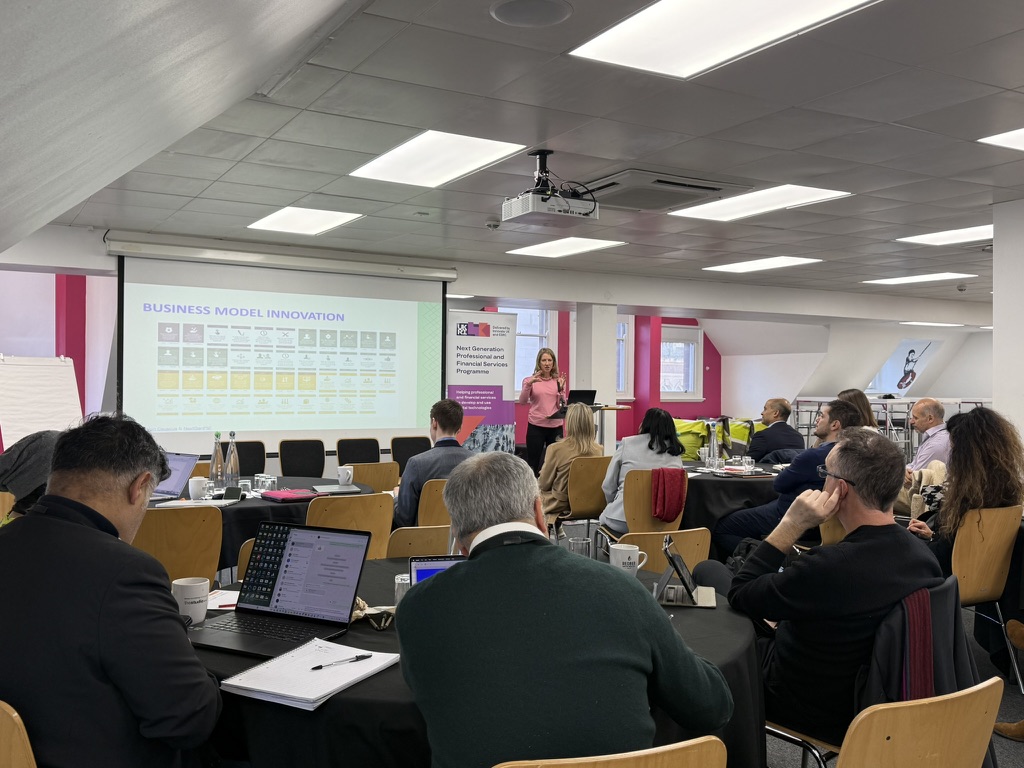
Whitecap Consulting was in Birmingham on 26th November for the final workshop in our three-part series with Innovate UK Business Connect, exploring innovation across the Professional & Financial Services sectors. Following earlier sessions on Responsible Innovation and AI Literacy, this workshop focused on Digital Adoption – a topic that is rapidly rising up the agenda as organisations look to unlock productivity, improve customer experience and strengthen competitiveness.
The session was opened by Winn Faria of Innovate UK, who outlined the importance of Professional & Financial Services and the work Innovate UK has been delivering to support technology-driven innovation in this space, especially for small and medium sized businesses.
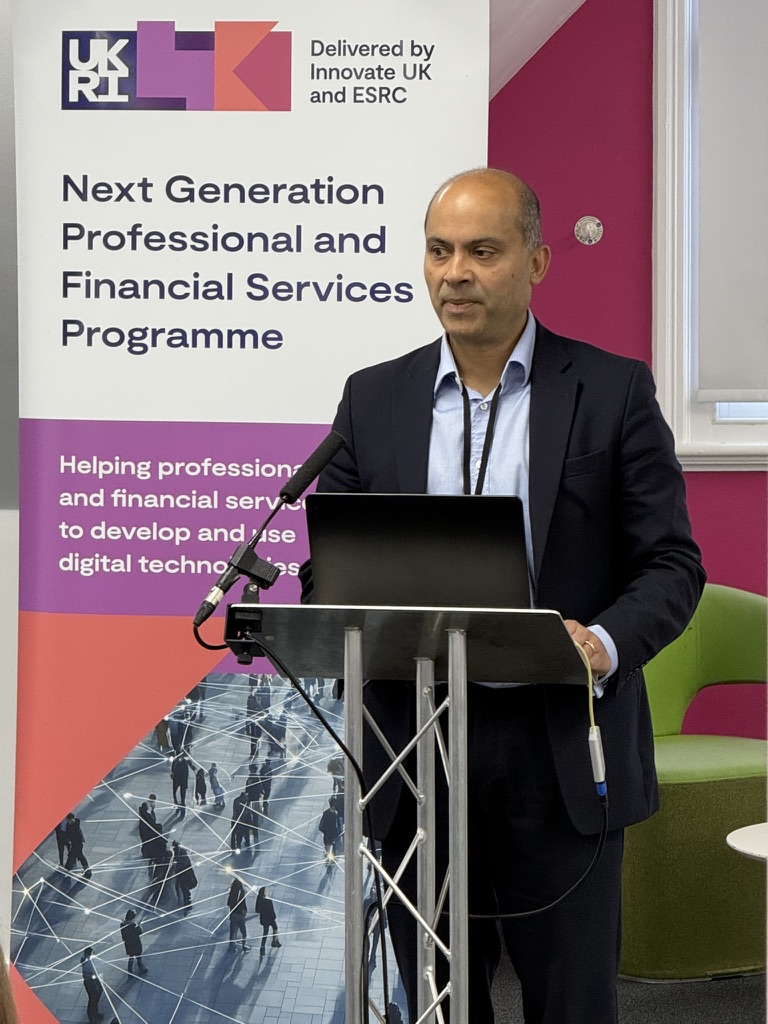
Keynote: The Importance of People in Digital Adoption
An insight packed keynote was delivered by Hilary Smyth-Allen, CEO of SuperTech WM, whose career has spanned the “triple helix” of industry, academia and policy. She emphasised the importance of adoption in making digital technology meaningful: innovation only delivers value when people use it, trust it and embed it into their everyday ways of working. In the West Midlands, this is especially significant. Professional & Financial Services are the engine room of the regional economy, accounting for around a third of all jobs and forming two of the eight priority industries in the new Industrial Strategy.
At the heart of digital adoption, Hilary stressed, are people. Bringing teams along on the journey is essential, but far from simple. Understanding who the true beneficiaries of adoption are is also critical. Internal teams need to be involved, but customers are often overlooked despite being the stakeholders for whom much of the value is ultimately intended.
 Key Themes: Understanding Adoption Through People, Problems and Possibility
Across the workshop, participants explored the idea that adoption rarely stays neatly contained within a single team or process – it creates ripples across the organisation. The Business Model Innovation Framework was used to examine how these ripples flow across offerings, experiences and supporting capabilities.
Several themes emerged:
-
Outside-in perspective is vital. Overcoming the “imagination deficit” (not knowing what you don’t know) requires exposure to new ideas, collaboration with peers, and safe spaces to explore.
-
Barriers and enablers can be decoded. A recently published government list of digital adoption factors offers a useful reference point. Assessing willingness, capability and capacity against each barrier helps organisations pinpoint what is really holding them back.
-
Experience matters. Adoption is as much about how people feel as it is about technology. Being brave, supporting people well and creating psychological safety are all critical to building momentum.
Panel Discussion: Insights on Adoption from Research, Industry and Practice
A panel discussion brought together four contributors with deep experience across digital transformation, AI, leadership and organisational change:
- Symeon Dionysis – Research Fellow, Nottingham Business School
- Victoria Parkinson OBE – Director, AI Skills Hub, PwC
- Dr Anjulika Salhan – Managing Director, System Holdings
- Caroline Walton – Fractional Chief of Staff, NED
While specific comments have been anonymised in this write up, the discussion surfaced a set of shared insights and reflections.
One theme was that good digital adoption is, fundamentally, good customer design. Organisations often focus on internal processes, but transforming how customers experience the service is where the most powerful gains lie. Another recurring observation was that the UK is an economy dominated by small and medium-sized businesses, making it crucial to ensure that adoption strategies work not just for large institutions but also for SMEs with constrained resources.
The panel also discussed the difference between vertical adoption (using digital technology to deepen competitive advantage) and horizontal adoption, which focuses on efficiency, collaboration and operational improvement. Both have value, but clarity on the purpose helps avoid aimless experimentation.
Skills development featured prominently. Leadership teams increasingly need a baseline understanding of technology to guide decision-making and set direction. Examples shared during the session illustrated how organisations are embracing adoption in practice, from AI-enabled data capture to organisation-wide AI rollouts accompanied by training programmes. Importantly, contributors warned against linking AI efficiency gains to headcount reduction, as this can create fear and stall adoption before it begins.
The conversation returned repeatedly to the theme of “human in the loop”, which has been consistent across all three workshops. However, the group noted that as digital twins and advanced models emerge, the “loop” becomes more complex and requires new thinking, as it can include humans and digital twins.
The panel also explored barriers to adoption – from cost and change fatigue to the overwhelming choice of tools and lack of clarity on objectives. Many organisations, it was noted, are tired of large-scale “transformation” narratives and instead seek practical, manageable changes that feel realistic and relevant.

Practical Advice: Where to Begin and How to Build Confidence
Participants discussed the most effective ways for organisations to begin or accelerate their adoption journey. Practical suggestions included:
-
Appraise where you are today, recognising that most firms are already partway into their adoption journey.
-
Prioritise people and skills, especially among leadership.
-
Be clear about the problem you are trying to solve, before exploring solutions.
-
Send scouts out – give people permission to find new information, ideas and partners.
-
Choose partners, not just vendors, seeking relationships that can grow and evolve with your organisation.
Confidence-building emerged as a crucial component of adoption. Clear communication of “why”, small guided steps, and psychologically safe environments in which to fail can all help teams embrace new technology – especially in regulated industries where failure is less tolerated.
The group also explored the importance of recognising and managing bias. Data, processes and systems often carry historical biases that can influence outcomes, particularly when used to train or inform AI tools. Regular bias scanning, diverse voices in design and testing, and conscious choice about which human is “in the loop” all help mitigate risks.
In the afternoon, the Whitecap team of Julian Wells and Michael Fletcher ran workshop for participants, which provided an interactive opportunity to engage with the frameworks from the practical Guide to Digital Adoption for Professional and Financial Services Firms, which was recently published by Innovate UK.
Looking Ahead
The workshop concluded the three-part series with Innovate UK Business Connect, bringing together insights from Responsible Innovation, AI Literacy and Digital Adoption. Across all three sessions, several consistent messages have emerged: the importance of people, the need for clarity of purpose, the importance of safe experimentation, and the role of trust (both in the technology and in the organisation itself).
Digital adoption is not just a technical challenge but a cultural one. As organisations in the Professional & Financial Services sectors look to the future, the ability to bring people with them – including customers, colleagues, leaders and partners – will be the defining factor in unlocking the full value of digital innovation.
Whitecap Consulting is proud to have supported Innovate UK in delivering this programme and looks forward to continuing to help organisations navigate and harness innovation across the UK’s regional economies.
Further Reading
Read the write up from all the workshops in this series here:
- Responsible Innovation (Edinburgh)
- AI Literacy (Manchester)
- Digital Adoption (Birmingham)
Read the Practical Guides here:
- Guide to AI Literacy for Professional and Financial Services Firms
- Guide to Responsible Innovation for Professional and Financial Services Firms
- Guide to Digital Adoption for Professional and Financial Services Firms