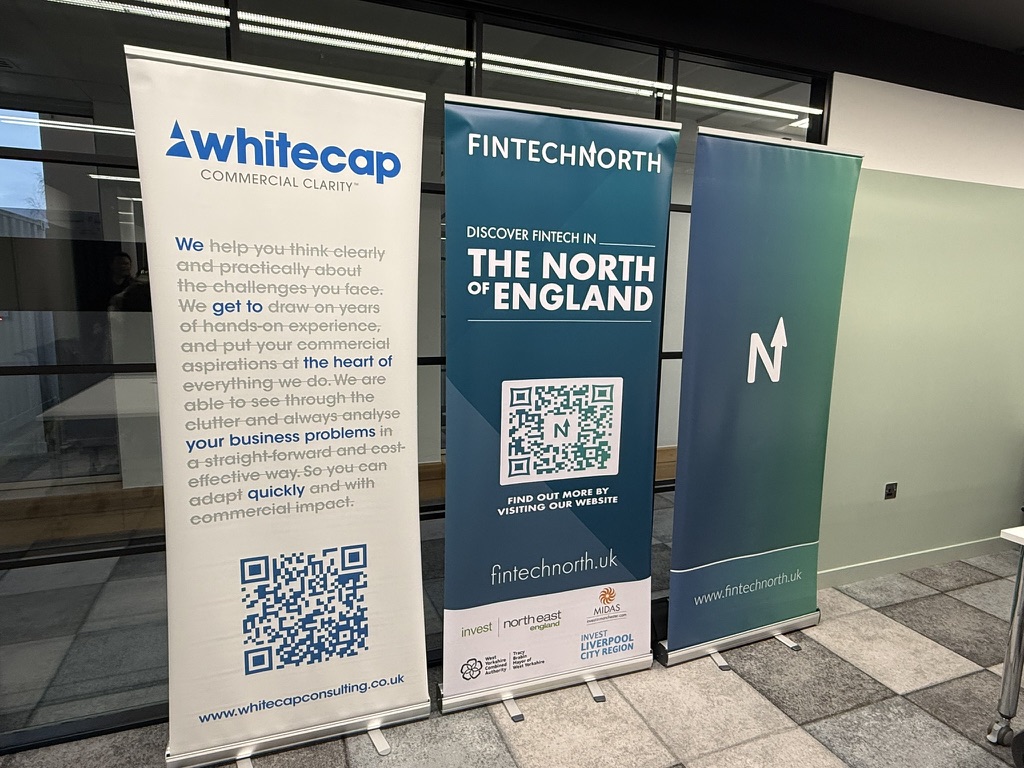
This blog summarises some of the outputs of what was an insight-packed day hosted by OneBanx on 13th January 2026 at the Yorkshire Building Society head office in Bradford. This was the third event in what has become an annual series, and was extremely timely, coming as the mutual sector gets to grips with the Government’s desire to double the size of the sector. This was the first year Whitecap has attended, and we were there with FinTech North.
The Mutual Future: Innovating for Growth in a New Era brought together leaders from across the mutual sector for a thoughtful and, at times, challenging discussion about what growth, innovation and relevance really mean for mutuals today. The speaker line up and audience were drawn from CEOs and senior leaders from building societies, credit unions, key partners and suppliers to the sector, as well as regulators and industry bodies.
One theme came through clearly and consistently, which is characteristic of events focused on the mutual sector: this was not a conversation about customers, but about members; not profit in isolation, but purpose with commercial discipline.
Innovation from within, not adopted from outside
A powerful opening contribution came from Colin Payne, Head of Innovation at the Financial Conduct Authority, who set the tone early on. Mutuals were framed not as a nostalgic remnant of the UK financial system, but as organisations with a vital role to play in the future economy, particularly in the context of inclusion, trust and long-term value creation.
Colin highlighted the importance of the inclusion economy, and noted that one building society has applied to its new Scale-Up Unit – launched by the Chancellor in Leeds in October – giving a subtle but important signal of confidence in the sector’s growth potential.
Some of the key soundbites from Colin’s session included:
- Innovation in mutuals can’t just be adopted – it needs to come from within, and with confidence.
- The challenge is not creativity, it is confidence. Innovation is not about creating something new, it’s about enhancing things and doing so in a way that gives something that is digitally different.
- Trust is a strategic asset. If we measure it, we protect it – and if we protect it, we can scale it.
- AI works best as human judgement with machine execution: freeing people to focus on the moments that really matter.
- The biggest risk for mutuals isn’t technology – it’s waiting for permission until innovation feels comfortable.
- “Treat innovation as a portfolio not a project” – run multiple controlled experiments
Colin firmly positioned innovation as evolution rather than reinvention. Looking ahead at the opportunities from Data, AI and infrastructure, he set out three interlocking areas where mutuals may be uniquely well placed to lead:
- Data as a trust engine: Mutuals may have a stronger licence to operate when it comes to data, grounded in long-standing member trust. If that trust can be measured as an asset, it can be protected, and ultimately scaled.
- AI and automation: AI was consistently framed as an enabler, not a replacement for people. Used well, it can remove friction, improve efficiency and free colleagues to focus on judgement, empathy and complex decision-making. There was a strong sense that mutuals can build AI that is more grounded, ethical and human-centred.
- Modern infrastructure: Topics such as digital assets and tokenisation were explored not as hype, but through a pragmatic lens: could they reduce cost to serve, improve resilience, or broaden reach? The focus remained on outcomes, not technology for its own sake.
 Eight years of open banking – and lessons for mutuals
Henk van Hulle, CEO of Open Banking, reflected on the eight-year journey since Open Banking was established: now involving over 330 organisations, including around 90 banks. Of particular relevance was the Commercial Variable Recurring Payments (CVRP) programme, which includes 31 participating organisations, all of whom will be invited to become shareholders in the new entity.
The underlying model was simple, and instructive for the mutual sector:
“Everybody contributes, everybody benefits, everybody pays.”
Multiple regulators collaborating with one another on Open Banking and Open Finance was another encouraging signal that systemic change is possible when incentives align.
Collaboration over caution
A recurring theme throughout the day was collaboration – and the distinction between sharing and truly collaborating. The mutual sector is rightly proud of how openly it shares learning, but several speakers challenged whether it goes far enough. This idea came to life through discussion of shared utilities, data platforms and co-owned infrastructure, and international examples were cited where multiple banks or mutuals operate on shared core platforms. This is still relatively rare in the UK, where the sector is very good at sharing, but not so much at collaborating. Steve Britain, CEO of Monument Technology, a modular banking platform provider, shared that the firm had originally anticipated partnering with one core banking system, but had concluded that it would be necessary to develop multiple partnerships in order to meet the varying demands of different types of financial services clients including building societies.
The core banking panel, chaired by Helene Panzarino from the Centre for Digital Banking and Finance offered a sobering but valuable reality check. Simon Taylor, CEO of the Melton (and Chair of the BSA), described their “North Star” not as a system, but as an ecosystem, but also highlighted just how long meaningful transformation takes (several years, including 6 months of contracting). The oft-repeated mantra of “adopt, don’t adapt” was acknowledged on this panel, albeit with an honest admission that few organisations actually do this in practice.

Branches, place and the “branchless branch”
Few topics on the agenda generated as much discussion as branches, and this was the original area of focus for this event when it launched in 2024. Building societies still account for around 32% of all UK branches, rising to over 40% in some areas. This remains a clear differentiator, but also raises questions about long-term sustainability.
Several sessions through the day related to branches, including a keynote from Stuart Fearn at OneBanx, a an insightful and data-rich slot from Paul’D’Ambra, CEO of Consectus and Will Carroll, CEO of Monmouthshire Building Society, as well as a more international perspective as part of a session from ACF Technologies and YBS.
Key data points grounded the debate included the facts that around 17% of over-65s still lack access to online services, ATMs continue to decline, and branch usage is skewed towards older demographics (according to CACI data).
Rather than framing this as decline, speakers explored adaptation, including the idea of the “branchless branch”, with services delivered through means such as pods, libraries and shared community spaces.
A standout example came from Will Carroll, who explained that flooding in the town of Monmouth forced an ongoing temporary branch closure but also led to the creation of a new community hub in a local library. this made for a compelling story of resilience, relevance and place-based innovation.
The future of mortgages – evolution or revolution?
The mortgage panel was chaired by Julian wells, Director at Whitecap, who was joined by Paul Denton (CEO, Scottish Building Society), Seeta Halder (Head of Data Insights, Nottingham Building Society), Kerri-Anne Sproson (Senior Strategy Lead, Skipton Group), and Adam Oldfield (CEO, Phoebus Software). During the session, the panel reflected on the current state of play in the market, the likely key developments in the next 1-2 years, the restraint placed on innovation in the sector by the underlying homebuying process, and what some of the radical changes to the mortgage market might be in the longer term.
The discussion around the current and short term market focused on subject areas such as the complexity of who owns the customer in a heavily intermediated market, the continued evolution of specialist lending in the UK, and the challenges relating to data. Kerri gave a great overview of the challenges of the current homebuying process, drawing on data from OPDA as well as Skipton Group’s work in this field via Skipton Building Society, LMS and Connells. This is familiar territory for us at Whitecap, due to our ongoing work with PEXA and the Future Property Transactions Group, which Skipton is also involved in.
In terms of radical suggestions for the future, ideas included reverse auctions for consumers looking for mortgages, ‘create your own’ mortgage product design, and the use of smart data to create pre-approvals for mortgages on houses you walk past which are for sale. Paul closed out this segment by summarising a future vision that many in the industry would like to see become reality:
“Pre-approved property meets pre-approved individuals”

Human judgement, AI execution
AI was of course, a key theme throughout the day.
The morning saw an insightful panel discussion led by James Brown, CEO of Leeds Credit Union, who was joined by AI guru Lucy Batley of Traction Industries, Bradley Elliott from ReplyComply, and Manila McLean of Somerset Bridge (formerly CIO at Newcastle Building Society).
We also had a joint session from Chris Ansara, CEO of DocStribute, and Louise Watt, CTO at Penrith Building Society. It was a practical walkthrough of how AI is being used to improve understanding of regulated customer communications and deliver better outcomes for members, including how a phased delivery approach allows organisations to realise value at each stage rather than waiting for a big bang rollout.
A keynote in the final session from Miriam Lloyd, Banking & Capital Markets Director at Microsoft, focused on the hot topic of AI. She described AI as “intelligence on tap”, noting that while it is powerful, it only valuable when it produces meaningful outputs. Human judgement remains critical; AI’s role is execution at scale. Without that balance, AI output risks becoming little more than noise.
The challenge posed by Miriam to the sector was deceptively simple:
“Where are the meaningful moments in the member journey, and how could they be enhanced by AI?”
 A sector with confidence in its future
The event fittingly closing slot from the Building Societies Association, delivered by Andrew Gall, Head of Savings & Economics, who shared insights and data on savings and deposits, under the title of “Community Capital: Why Branches Still Matter in a Digital Age.”
What emerged from the day was not a sector fearful of change, but a sense of one increasingly confident in its own distinct strengths. Mutuals are not competing despite their purpose, they are competing because of it.
With trust treated as an asset, innovation approached as a portfolio, and collaboration embraced at a deeper level, the mutual sector is well placed not just to endure, but to lead in a new era of UK financial services.
At Whitecap Consulting, we were proud to be part of these conversations and to continue to support mutual organisations and the sector overall, as it steps up its drive to translate purpose into practical, sustainable growth.
Further reading: Mutual & Financial Services insights from Whitecap
Reports:
- Building Societies Report 2025
- AI for Services Report 2025 – Technology & Innovation in Financial & Professional Services
- Strategic Landscape Report for Mutual Insurers & Friendly Societies
Building Society blogs series 2025:
- Blog 1: Strategy & Mutuality
- Blog 2: Mortgages
- Blog 3: Savings
- Blog 4: Branch of the Future
- Blog 5: Homebuying Process
- Blog 6: Green Finance
- Blog 7: Diversification & Collaboration
- Blog 8: Technology
- Blog 9: Regulation, Policy & Risk